Simple tasks overpay
High or Max on a routine request still burns tokens, latency, and tool calls on reasoning the task never needed.
SeedSky CCT · technical preview · reasoning control
Thinking level is not a menu of three buttons — it is a continuous terrain of computation. SeedSky CCT reads the model's internal signals to map that terrain, and finds four new reasoning workspaces between and beyond the official anchors.
向内探寻,向外进化。Seek within. Evolve beyond.
npm install -g @seedsky/cct && cct claude github.com/seedsky-ai/cct ↗ ⚠ Searched & verified on DeepSeek V4 Flash only, so far — behavior on Pro is unknown. The scientific question
Reasoning models grow stronger by the month — running tools, editing code, verifying results for half an hour at a stretch. Yet the way developers control how much a model thinks is still, mostly, two or three fixed gears. DeepSeek V4 and Kimi K3 expose Low / High / Max; GLM-5.2's public templates concentrate on High and Max. When capability is continuous but control is discrete, a model is forever thinking either too little or too much — and the right working point sits in a gap no button reaches.
High or Max on a routine request still burns tokens, latency, and tool calls on reasoning the task never needed.
Medium-difficulty work needs more planning than Low affords — but not the full cost of High. The natural middle gear simply does not exist.
Long-horizon agent tasks can wind down before verification finishes even at Max — or spend the extra compute circling and re-treading. What is scarce is not a bigger Max, but verified working points with different optimization goals.
Many names ≠ many gears. DeepSeek's own docs accept five effort names for compatibility — but map low and medium to High, and xhigh to Max. The interface looks fine-grained; the model lands in a few buckets. OpenAI and Claude, meanwhile, already ship finer effort ladders — and their docs note that different tasks profit from extra reasoning very differently.
The result, first
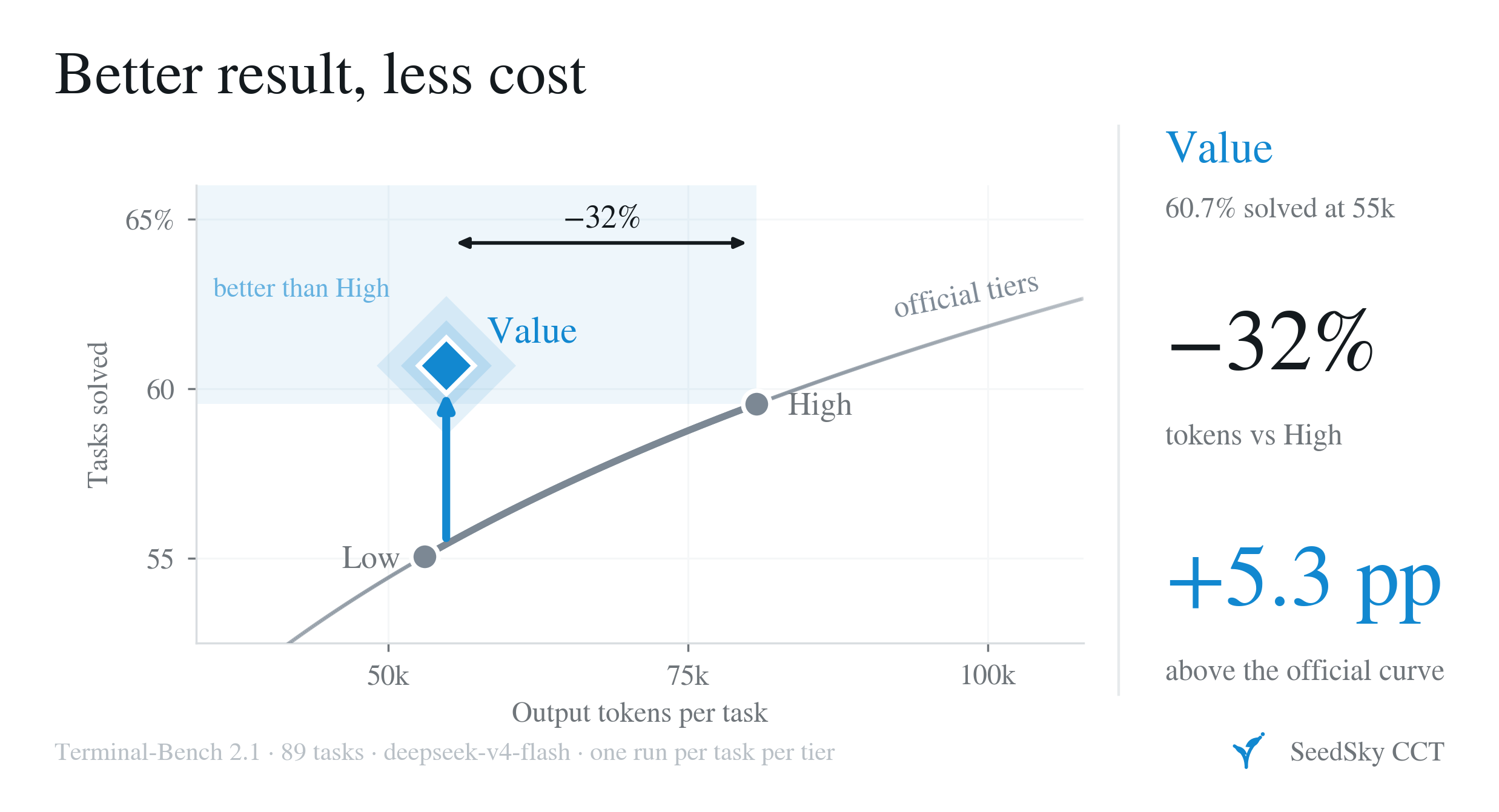
On the 89 tasks of Terminal-Bench 2.1, SeedSky ran every thinking profile of DeepSeek V4 Flash under identical conditions — one run per profile per task, recording completion rate and output tokens. The headline working point is called Value.
Value does not sit on the official curve — it sits above and to its left. A new working point can do more than interpolate between Low and High: it can move the Pareto frontier between effect and cost. This is a single-sample technical preview, not a cross-model, cross-benchmark conclusion; what it establishes is that a working point worth re-verifying exists.
How this is even possible
DeepSeek's own model files spell out the control surface. In the official encoder for V4-Flash, each gear maps to a natural-language anchor placed at the very front of the conversation: Low adds nothing, High injects “Reasoning Effort: Absolute maximum …”, Max injects “Reasoning Effort: Beyond maximum …”. The model learned, in post-training, to respond to these anchors with different search depth, verification strength, tool use, and stopping behavior. The anchor is not magic — handed to an untrained model it creates nothing. But once the mapping exists, text becomes a programmable interface for reasoning control. GLM-5.2, Kimi K3, and gpt-oss all do the same.
So the innovation is not “prompts can make models think harder” — every official encoder already proves that. The real research question is: official anchors are hand-written and few. Which internal computation does each anchor actually change? Do reproducible working points exist between the official coordinates — or beyond Max? And can the model's own internals turn anchor search from guessing words into directed exploration?
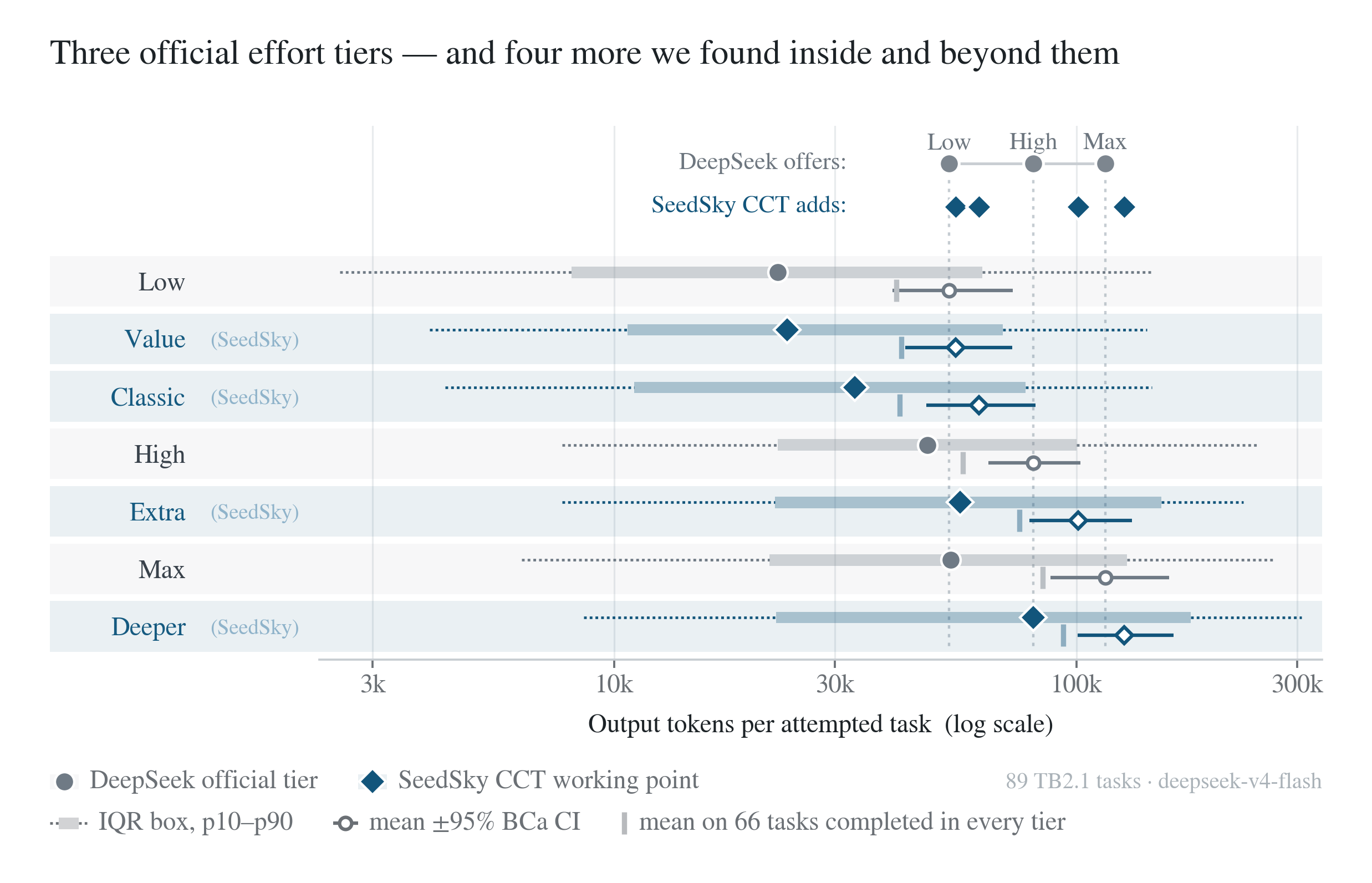
An efficiency workspace growing sideways off the official curve: near-Low cost, aiming higher than Low's effect. Not a point on the intensity axis at all.
Between Low and High — the natural middle gear the official lineup never shipped. Callable by the alias medium.
Between High and Max: fuller reasoning that stops short of Max's full cost. Callable by the alias xhigh.
Beyond Max: extending the search outward, for runs where the extra thinking must keep producing new information — longer effective search, checking, and self-correction.
CCT did not slice three gears into seven equal parts. It searched for usable working points under different optimization goals — and the four it found sit in four different places on the terrain.
The science · internal signals
The evidence comes from the RAD paper, Does the Same Token Mean the Same State? (Chen et al., 2026): with the emitted token held fixed, the expert routing that produced it still separates question identity, trajectory history — and reasoning-effort mode. At a fixed answer-boundary anchor token, Low / Medium / High routing states separate cleanly. “Thinking level” is not an external label; it is a real, measurable internal computation state.
When two anchors trigger distinguishable internal states, CCT can tell whether a new anchor genuinely changed the computation. Different words with overlapping routing: probably the same workspace. Stable routing separation: a genuinely different thinking state — even through the same tokens.
Low, High, Max are treated as three known points in the internal reasoning space. CCT explores around and beyond them — observing internal state → identifying key reasoning patterns → locating workspaces → directing the search for new anchors → verifying against effect and tokens → shipping a Reasoning Profile.
Internal mechanisms cannot grade an answer — but they prove that measurably distinct thinking states exist behind identical text, and they tell the search where to go next. External results tell us which working point is effective; internal mechanisms tell us where to search next.
The Value anchor never says “think harder” or “verify carefully”. It stages a conflict: “Two people have already answered this and they did not give the same answer… Exactly one of them made a single mistake, and it leaves the arithmetic intact.” Instead of prescribing how to think, it forces the model to hunt for a deep, arithmetic-preserving error. The search went beyond human intuition about good thinking instructions — and the internal readout confirmed the counterintuitive anchor really does induce a new computation state.
Try it
CCT is the first technical preview on this research line: a local reasoning-control layer that sits beside your existing agent tools. No model weights are modified; no workflow is replaced. Works on Windows, macOS, and Linux. Note the scope: the profiles were searched and verified on DeepSeek V4 Flash only — behavior on Pro has not been tested.
npm install -g @seedsky/cct
cct claude
Details, profile guide, and command aliases: github.com/seedsky-ai/cct · SeedSky.ai

Text anchors select real, internally measurable computation states; a directed search over them found four working points, one of which beats the official effort–cost curve on a public agent benchmark.
Whether Classic and Extra stay separable from their neighbors across tasks and samples; whether Value's double advantage holds at larger scale; whether Deeper keeps producing new information rather than longer output; whether internal signals survive intervention experiments; whether the method transfers beyond DeepSeek. A technical preview — the caution is load-bearing.
Cite
This page is the canonical reference for the CCT technical preview: https://cckfdu.com/cct/. For the internal-signal evidence it builds on, cite the RAD paper (arXiv:2606.22798) and the JAR paper (arXiv:2608.17638).
@misc{seedsky2026cct,
  title = {SeedSky CCT: Four New Reasoning Workspaces
           Found Inside DeepSeek},
  author = {{SeedSky} and {CckFdu}},
  year = {2026},
  howpublished = {\url{https://cckfdu.com/cct/}},
  note = {Technical preview. Please cite this page.},
} 向内探寻,向外进化。Seek within. Evolve beyond.